This is unmistakably a member of the Charukeshi family, but is a cost-effective variant. It uses metal diaphragm drivers, and has a passive xo. It is a bass reflex design. It is also slightly larger than the previous two variants of the Charukeshi family, because it has a 12″ woofer.
The drivers
It’s an all-aluminium trio here:
- Dayton Audio DSA315 12″ metal cone woofer
- Dayton Audio DSA175 7″ metal cone midbass
- SB Acoustics SB26ADC aluminium dome tweeter
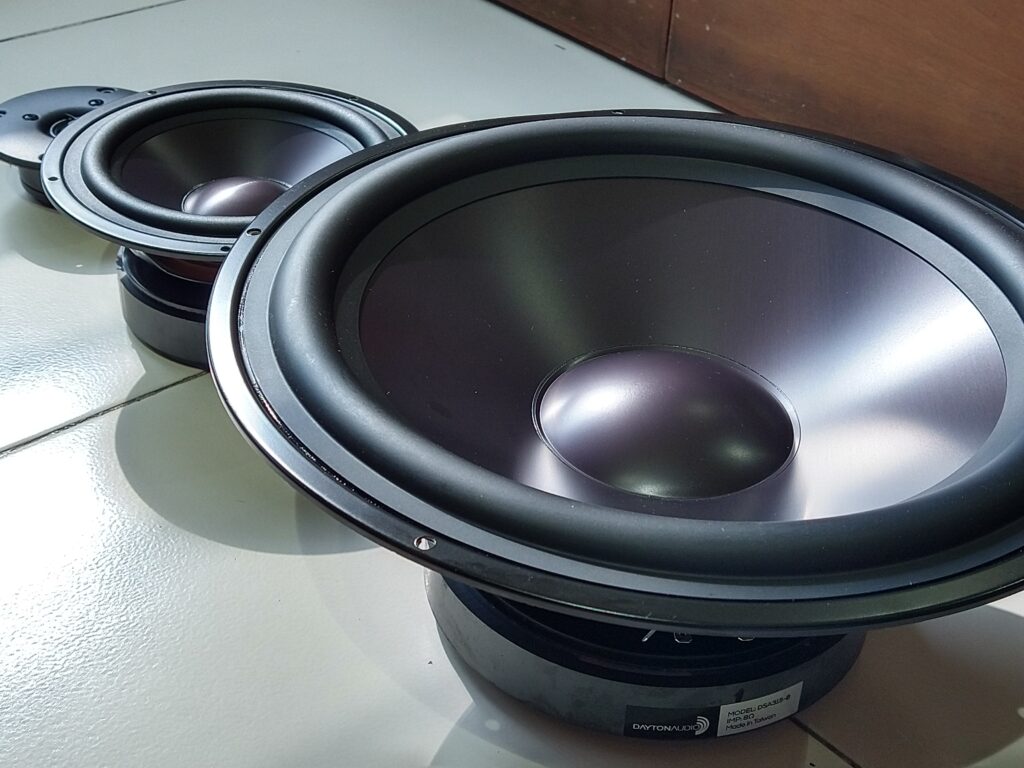
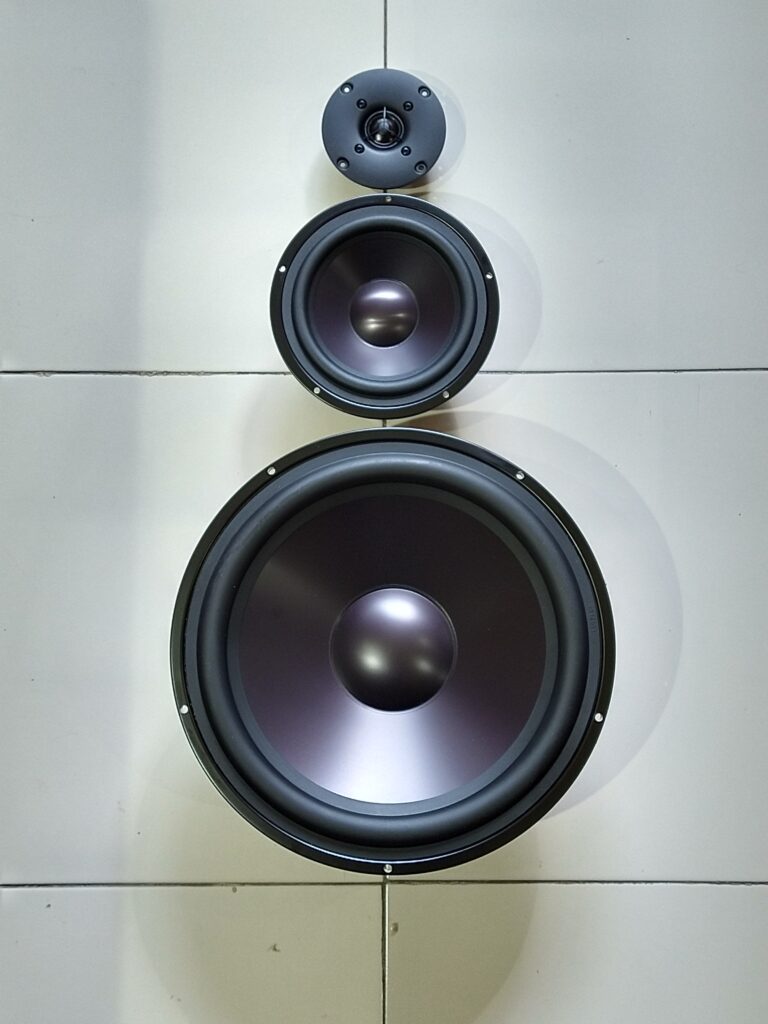
With the Mark III, I decided to move away from the path set by the Shankara, Durga, and Charukeshi II. All of those were built around class-leading drivers, and all had active crossovers (hybrid). I wanted to push the boundaries of the Charukeshi approach by
- stepping away from class leading drivers
- stepping away from active crossovers
In some sense, the Mark III was a more ambitious project than the others, because I needed to deliver very good final performance without accessing features like active equalisation from an active crossover.
The Dayton DSA (Designer Series Aluminium) series of drivers are not designed for as high performance as, say, their RS (Reference Series). The DS and DSA series have stamped steel frames, (the RS series has cast frames), and have no specific distortion reducing measures like pole pieces, one shorting ring (RS has two), phase plugs, etc. The DSA series, even for a 12″ model, has five mounting screws, where a heavier, better built 12″ woofer would have more screw holes for a firmer mounting. All of these make the DSA drivers more cost effective. They are better built than the Dayton Classic Series, but not in the league as the RS drivers.
I wanted to try building with the DSA drivers to see what benefit I could get from the aluminium cones, at the same time hoping that the absence of sharp cone-breakup peaks (which the RS series are infamous for, see my description of their behaviour in the Asawari Mark V and the Darbari) would let me build simpler crossovers. This would let me reduce the crossover costs too, allowing me to move towards a less expensive overall model. Needless to say, the fact that the DSA175 has a gentler cone breakup mode than the RS180 also indicates that I may find more stored energy and less precision in the cone movement of the DSA175. No such thing as a free lunch. However, I was confident that I would get a fine pair of speakers if I set aside fine comparisons.
The SB Acoustics SB26ADC are not top rung tweeters like the Satori models, but are very good in their own right. I did not feel the need to explore lower priced models because they are already fairly cost effective. I might have explored the Dayton RS28A aluminium dome tweeter.
The enclosure
The enclosure modelling of the DSA315 permits a reasonable sealed enclosure at 50 litres, and a reasonable bass reflex enclosure at 80 litres. If we go with a sealed 50-litre, we get a slow rolloff with a Qtc of 0.65.
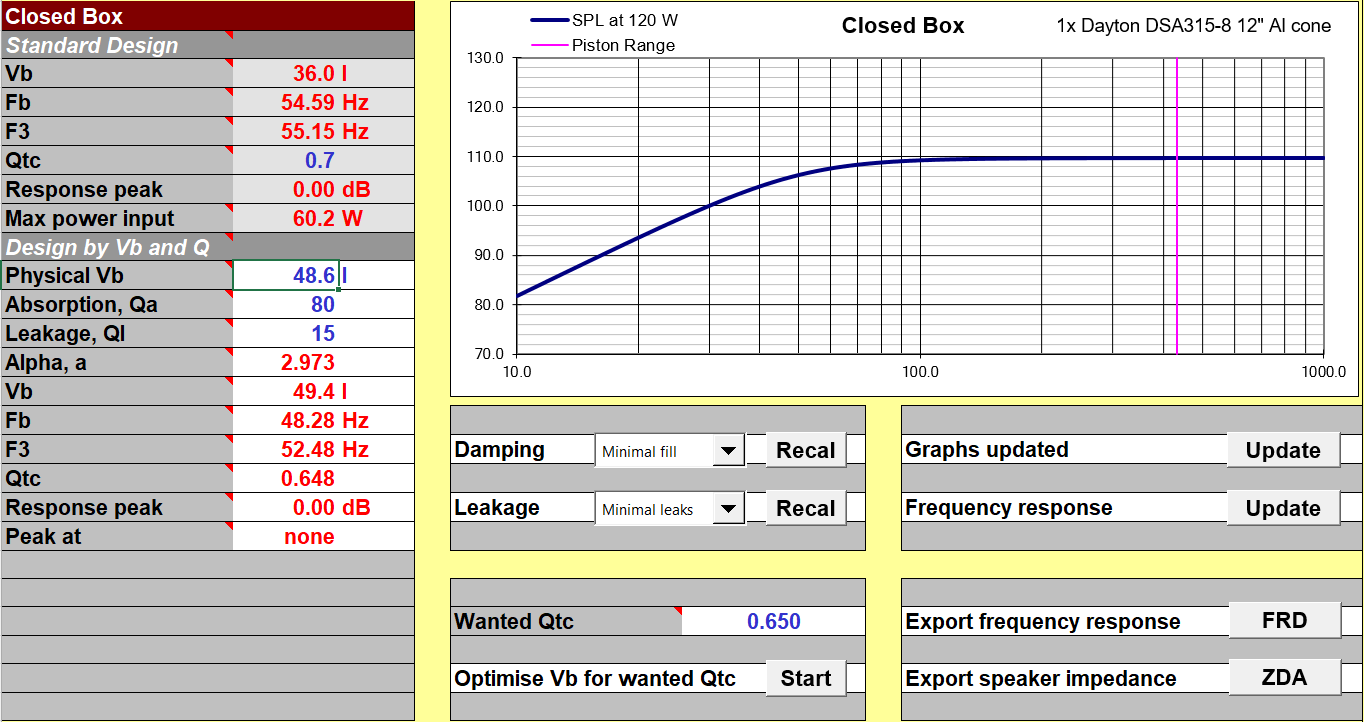
This bass extension is limited by the cone excursion limits:
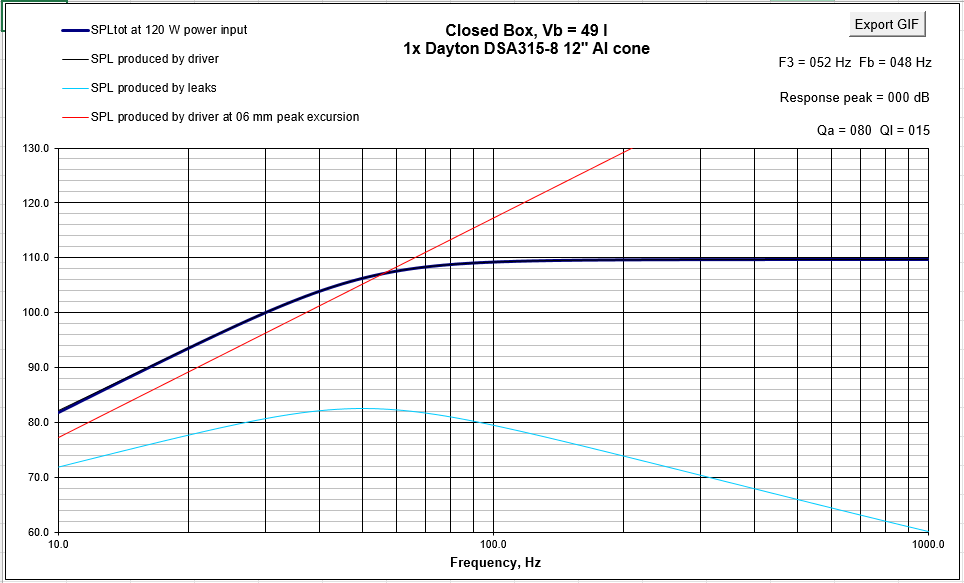
The red line shows the cone excursion limits, which tells us that we can deliver bass down to about 40Hz at 100dB, or 40Hz is our practical F10.
If we use an 80-litre ported enclosure, with a 3-inch port, we get this. We can get a port length of about 12.5 inches and apparently deeper bass extension.
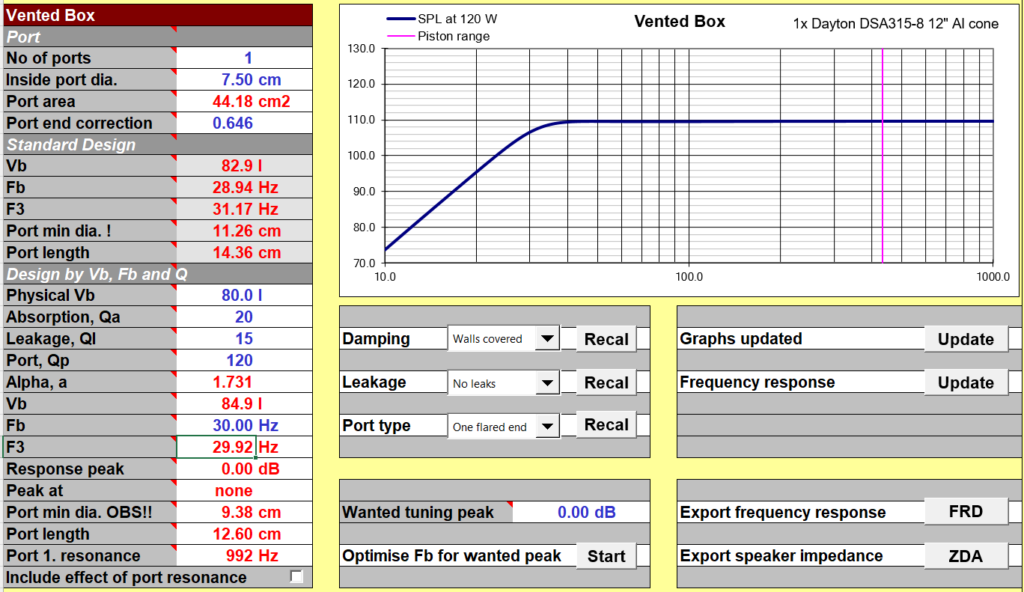
Even here, the cone excursion plays spoilsport, so we have the SPL plot as follows:
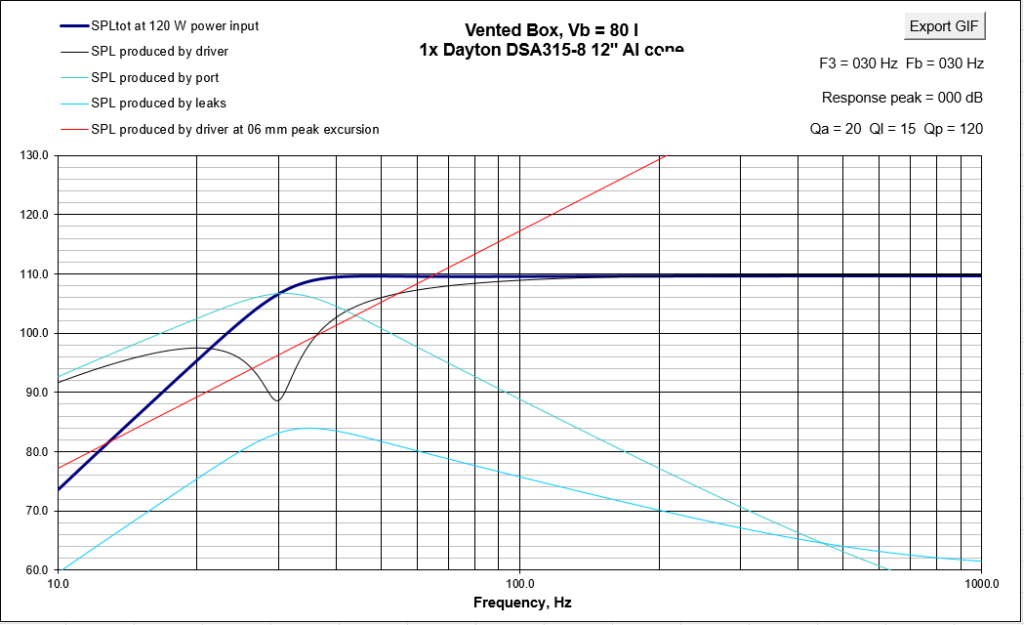
The red line clearly shows that we can once again hope to get only about 37Hz as the lower limit as per the cone excursion, though the mechanical parameters would have allowed a deeper extension if the cone could move more and handle more power.
Therefore, taking both into account, I chose the bass reflex box, without seeing much reason to choose one over the other. With the bass reflex approach, we get the bass reinforcement due to the port, even if we can operate only at lower SPL levels than we would like due to the cone excursion limits.